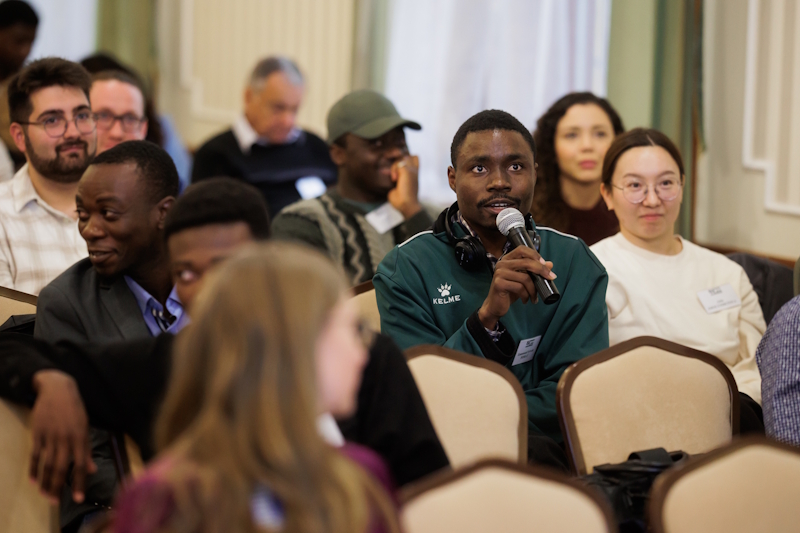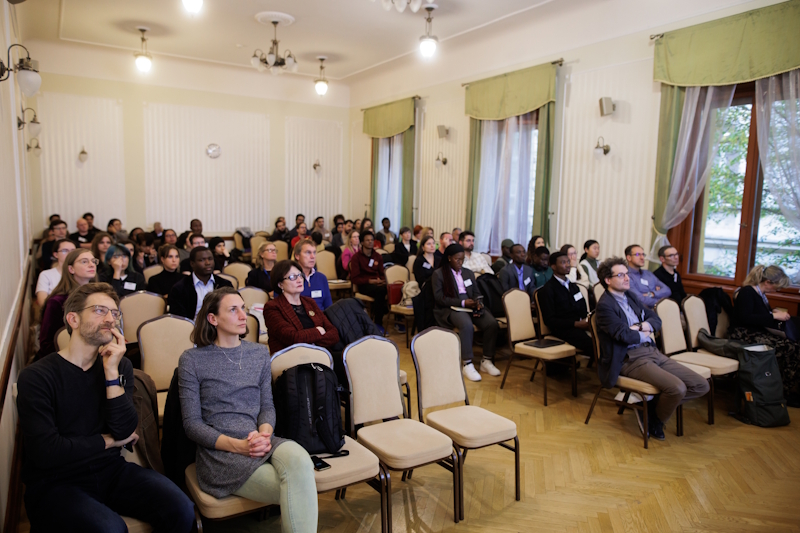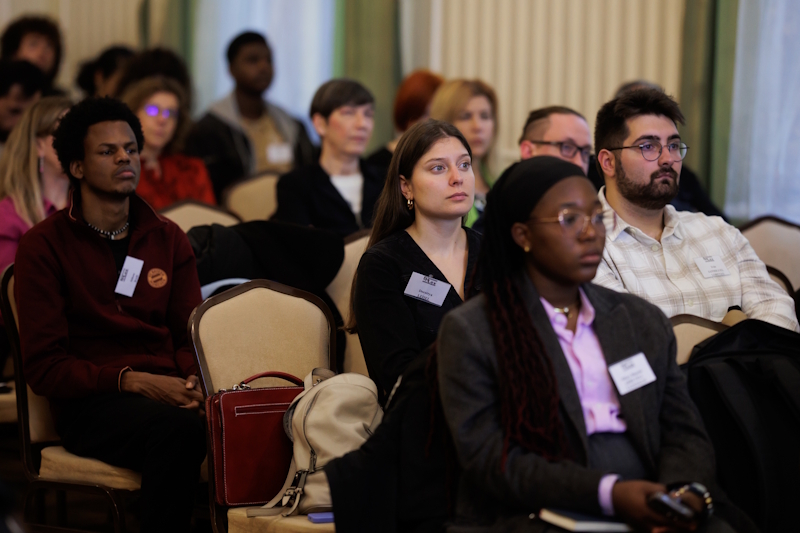

On behalf of my classmates, I’m very happy to present a short summary “Report” of the EMLex Career Day 2025, which took place in Budapest on the 10th of November.
This event was a wonderful opportunity for us to connect what we study in the EMLex programme with real professional fields from dictionary-making and publishing to artificial intelligence and language technology.
The day started at the Research Centre for Linguistics, where we were welcomed by Professor Gábor Prószéky, the director of the centre and founder of MorphoLogic, a Hungarian language-technology company.
He gave a fascinating talk about the link between linguistics, mathematics, and language technology.
He explained that the starting point of his work was a system called Humour, a morphological analyser functioning as a speller, hyphenator, and inflectional thesaurus one of the first Hungarian tools able to understand how words are formed and related.
Professor Prószéky also traced the evolution of computational linguistics: from statistical approaches in the 1990s, to neural networks in the 2010s, and finally to what we now call artificial intelligence.
His current AI model, PULI, is a neural network trained through machine learning, similar to GPT-type transformer models.
He explained how an artificial neuron processes information through several layers, forming a multi-layered neural network, and how transformers, like GPT, are a special kind of network that can process text efficiently and understand complex word relations.
It was eye-opening to see how AI and lexicography are increasingly connected and how linguistic theory supports technological innovation.
Next, Dr. Veronika Lipp and Kata Heller presented the work of the Institute for Lexicology and the Comprehensive Dictionary of Hungarian.
We then took part in a hands-on workshop where we learned how a Hungarian dictionary entry is structured and how lexicographers collect and process wordsand showed us the original sources of the newspapers, and archives which are later digitised and included in the dictionary database.
It was fascinating to see how an entry develops from real language examples to a fully edited form, and how even obsolete or rare words are preserved to document the linguistic history of Hungarian.
In the afternoon, at Károli Gáspár University, we attended several inspiring presentations.
L’Harmattan Publishers spoke about academic and open-access publishing, followed by Barbara Csapody from Xeropan, who introduced an AI-based language-learning app that adapts to each learner’s progress.
Then Laura Neuhaus from Duden showed how editors deal with sensitive or outdated words, how they use corpora such as DWDS, and how their internal production system Du-Plex organises dictionary data.
We learned that Duden follows a descriptive approach, reflecting how language is actually used, and that lexicography today combines linguistic precision with social awareness.
After a coffee break, we joined a round-table discussion with former EMLex students.
They shared their career experiences in research, publishing, translation, and language technology.
It was truly motivating to hear their stories and to see how diverse and international the EMLex network has become.
After that, Ilan Kernerman presented Lexicala, a platform providing multilingual lexical data and language-technology solutions used in dictionaries, translation software, and AI systems showing again how lexicographic data serve real-world applications.
Finally, we met Melinda Antal, a recruiter from Human Excellence Digital and a graduate of Károli University.
She gave us practical career advice and explained which skills are most valued today for linguists and lexicographers entering the job market.
The day ended with a networking dinner, where students, alumni, and professors could exchange ideas in an informal atmosphere.
Overall, it was a rich and inspiring day, combining academic, technological, and professional perspectives on lexicography.
On behalf of the whole EMLex cohort 2024–2026, I would like to sincerely thank Dóra Pődör and all the organisers, professors, and speakers for preparing such an engaging and motivating event.
By Nouhaila Zine Elabidine (Student representative)