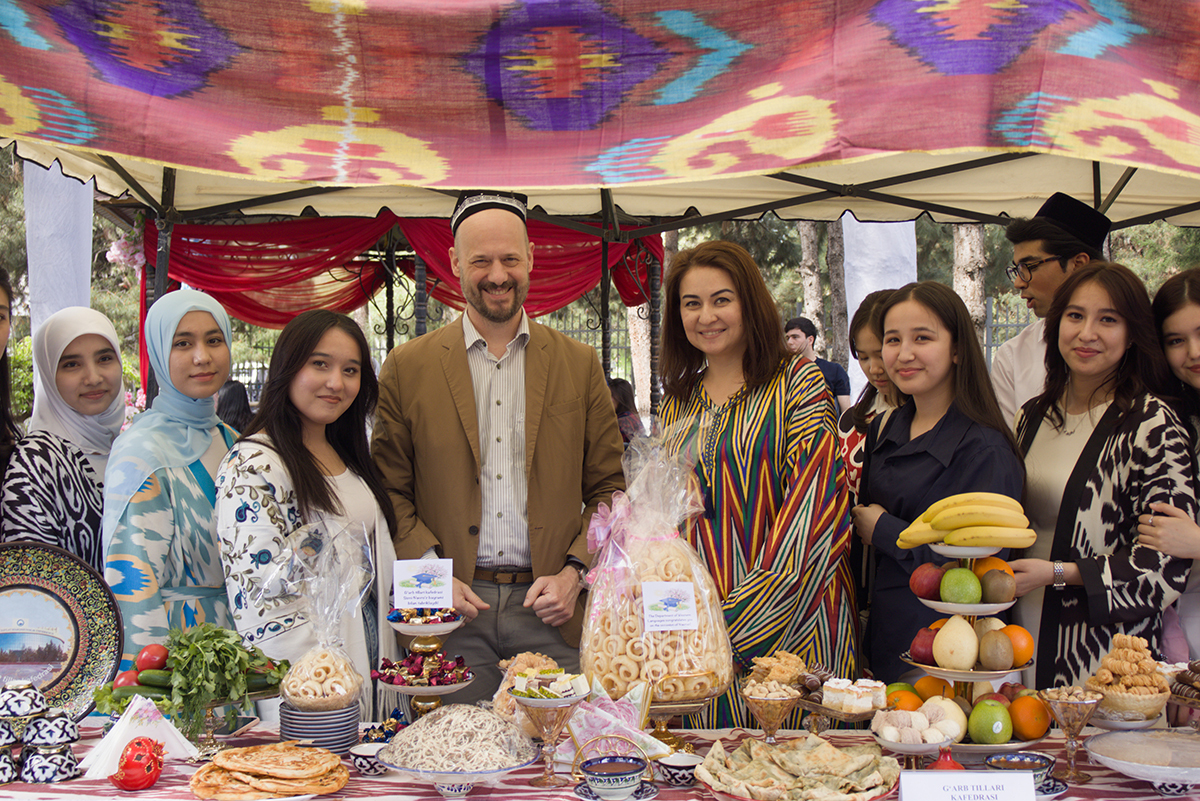

Don’t be afraid. Give it a try. It’s worth it —that’s the key message from Professor Miklós Péti, Associate Professor, Department of Literatures and Cultures in English, who spoke about his recent experiences during his visit to Tashkent State University in Uzbekistan. He described an education system that very much resembles ours, but with a community of very active students who want to get involved in their classes. He was also inspired by new methods of teaching that he witnessed there. Overall, he recommends such enriching experiences to every educator and student who wants to gain new knowledge and broaden their horizons.
In which country and at which institution did you work or conduct research, how long did you stay there, and what was your specific area of focus?
In late March and early April 2026, I went to Tashkent, Uzbekistan, where I was teaching at the university called TSUOS. It’s the Tashkent State University of Oriental Studies. TSUOS is a major university where many languages are taught—not just Western languages, but also Eastern ones. I was giving classes in English literature for English majors, both at the BA and the MA levels.
What were the most significant differences between the education system there and the one we have here in Hungary?
Well, interestingly, they are not that different. They also have lectures and seminars, as we do. But what struck me, and what I really enjoyed, was that students were very active in the seminars. I happened to arrive during a week when there was some kind of a midterm assessment, so students were giving presentations. I also attended a class where they were completing multimedia projects about Jane Eyre. So there was a lot of activity in the classroom, which I really enjoyed. I took a lot of photos of that—students working in little groups on specific aspects of Jane Eyre, for example, or, in other cases, giving presentations. I was also in classes where I had to give lectures, sometimes to large audiences. There was one lecture room with about 100 second-year BA students. I gave them a talk on the idea of nature in early, mid-, and late 18th-century English poetry. They really enjoyed it, and what was particularly interesting was that during the lecture they were again very active—it became quite interactive. Whenever I asked them a question, they were eager to respond. When I asked, “Who wants to read this poem?”, they immediately raised their hands and said, “I want to read.” Also, they spoke beautiful English and read the poems very nicely.
Was there any method or approach that you found particularly inspiring or worth adopting here as well?
I attended a creative writing class by a young colleague, Anvar Musayev, and he was adapting the methods of creative writing to various modern media forms, such as cartoons, blogs, and other new formats. I found that particularly interesting. It was essentially about storytelling—how you can tell a good story in the modern world, sometimes using modern methods—and I really liked the way he approached it. Also, I think my colleagues were methodologically impeccable. I really enjoyed all the classes I attended, and I could see that there was a very strong and supportive relationship between instructors and students. The students were clearly very fond of their instructors, and the instructors were very fond of their students as well. So overall, it was a very nice experience.
Do you plan to continue or expand your collaboration with international partners in the future?
Definitely. I think this is one of our priorities at the English Institute—to connect with as many international partners as possible. It is really important for students of English studies, to get to know other cultures, English-speaking cultures as well as others. We are also very pleased to welcome international students coming to us. We are working very hard on this, together with Judit Nagy, the Vice Dean for International Affairs. She is highly competent in this area and has extensive connections with partner institutions. We are very happy to support her and to work together with her to establish new partnerships.
What advice would you give to young educators who are considering gaining experience abroad?
Don't be afraid. Give it a try. It's worth it. I've been abroad many, many times, and I understand that it is always difficult to leave the safe space of home and step out into the unknown. In the case of Uzbekistan, I had never been to Asia before, for example, so it was a completely new experience—but it turned out to be a wonderful one that really broadened my horizons. All the knowledge that I gained there and brought back—cultural knowledge, geographical knowledge—the people I got to know, and the way I could expand my network, both professionally and personally, was just wonderful. So it is definitely worth trying, and I would recommend it to every young educator to embark upon this enterprise, to go abroad and gain new experiences.